| News Details |
| China’s Failed Mediation in Afghanistan and Pakistan Conflict and Indian Options | | 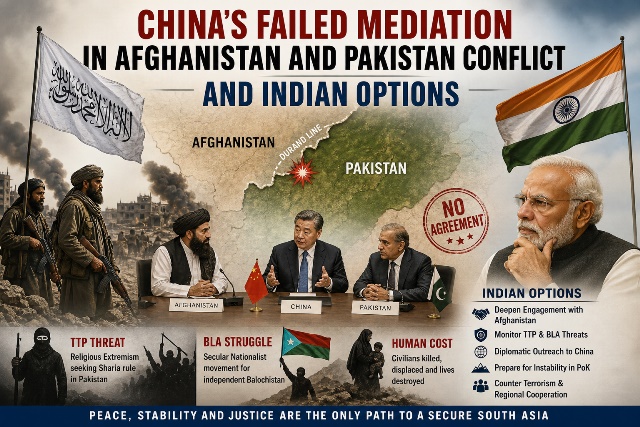
By Fatima Baloch
In late March and early April 2026, Pakistani and Chinese media reported that China had brokered ceasefire talks between Pakistan and Taliban-led Afghanistan. Delegations from Pakistan, Afghanistan, and China held informal, week-long discussions in Urumqi, the capital and largest city of the Xinjiang Uyghur Autonomous Region in northwestern China, from April 1 to April 7, 2026. The meetings aimed to de-escalate tensions and address border security issues following the so-called Pakistan’s Operation Ghazab lil-Haq, which began in late February. The mediation efforts were aimed at establishing a durable ceasefire and peace between the warring parties.
It is to be noted that previous mediation efforts were arranged by Qatar from October 18 to 28, 2025, in Doha. Mediation talks between Afghanistan and Pakistan, facilitated by Türkiye and Qatar, were also held in Istanbul from October 25–30, 2025, with a follow-up high-level meeting on November 6, 2025. However, including the previous efforts by Muslim countries, the Chinese-led April 2026 Urumqi talks also failed and ended without a formal, binding agreement. This is due to the double standards of China, Saudi Arabia, and Turkey. Instead of pressurizing Pakistan by stopping economic and military aid, these countries do not understand Pakistan’s internal core issues of conflict with Tehrik-i-Taliban Pakistan (TTP) and the Baloch separatist Balochistan Liberation Army (BLA), and they unconditionally support Pakistan, which bombs major Afghan cities, kills innocent people, and daily violates Afghan sovereignty. According to UN reports, approximately 115,000 Afghans have been forced to leave their homes due to the fighting. The UN mission in Afghanistan reported that 56 civilians were killed, including 24 children, by Pakistani military operations between February 26 and March 5, 2026, and Pakistan’s aggression still continues.
It is important to note that years of counterinsurgency operations and guerrilla warfare have strained the Pakistan Army, raising concerns about long-term military fatigue and internal instability. Further, since the Afghan Taliban 2.0 came into power on August 15, 2021, Pakistan has been facing serious security and existential threats from Tehrik-i-Taliban Pakistan (TTP) and separatist organizations like the Balochistan Liberation Army (BLA) in Khyber Pakhtunkhwa and Balochistan, respectively. In response, on October 14–15, 2025, Pakistan started a war against Taliban-led Afghanistan, targeting infrastructure and closing trade routes, which further strained Afghanistan’s fragile economy. The objective was to internationalize Pakistan’s internal conflicts by bringing Saudi Arabia, Qatar, Turkey, and China into mediation, supporting its stance against Afghanistan, and coercing the Afghan Taliban security command into fighting Pakistan’s war against the ideologically aligned TTP and nationalist BLA.
If the Afghan Taliban were to take up arms against the TTP—who fought alongside them against the United States and NATO for twenty years—it could result in internal revolt and public anger among the Afghan people. Pakistan could exploit such a situation to trigger a 1992-style Afghan civil war. It is very unfortunate that so-called mediators deliberately do not understand that TTP and BLA are internal matters of Pakistan and ignore Pakistan’s objectives.
It is also unfortunate that mediators, along with many so-called regional experts and defence analysts, misinterpret the difference between the Balochistan Liberation Army (BLA) and Tehrik-i-Taliban Pakistan (TTP). Some even claim that both are the same or maintain close coordination and are supported by Taliban-led Afghanistan, but this is incorrect. In the context of the Afghanistan-Pakistan war, we must clearly differentiate between TTP and BLA.
The Baloch are presented as an Arab-raced, secular, and moderate nation. The Baloch national struggle is described as a fight for an independent Balochistan since its claimed occupation by Pakistan on March 27, 1948. This struggle is portrayed as non-religious and based on an ideology aimed at disintegrating Pakistan, similar to what happened in 1971 with Bangladesh, seeking an independent and secular republic of Balochistan. Previous Baloch insurgencies were led by tribal chiefs and Sardars, whose fighters were largely uneducated. It is now argued that the Baloch national armed struggle has shifted from tribal leadership to common, educated Baloch. The current insurgency, under the leadership of Baloch Raji Aajoi Sangar (BRAS) and BLA, is described as consisting of educated fighters. Being non-religious, secular, and moderate, it is claimed that an independent Baloch republic would pose no threat to neighboring countries or the wider world.
In contrast, TTP came into existence in 2007 during the Afghan Taliban’s fight against the United States and NATO in Afghanistan. TTP is a hardline religious jihadist organization fighting to defeat the Pakistan Army and establish an Islamic Sharia system in Pakistan. If the Pakistan Army were to collapse, as happened with the government of Ashraf Ghani in Afghanistan, then TTP, according to its ideology, could expand conflict beyond Pakistan. It is argued that TTP already has a presence in Pakistan-administered Kashmir and may further expand its operations.
We understand that TTP is not fighting for the same reasons as the secular nationalist BLA, and that BLA and TTP have nothing to do with each other. It is also noted that during BLA operations “Herof 1.0” and “Herof 2.0” in August 2024 and January 2026, respectively, when Baloch fighters reportedly took control of multiple cities, TTP did not launch any parallel offensive to support them or engage the Pakistan Army. They also did not carry out similar operations in Khyber Pakhtunkhwa or Pashtun-dominated areas of Balochistan.
Baloch are not fighting for Pakistan but for Baloch national identity, while TTP, according to its ideology, seeks an Islamic system within Pakistan and claims to represent various ethnic groups including Punjabis, Sindhis, Pashtuns, and Kashmiris. Therefore, it is argued that if the Pakistan Army were to collapse, TTP might oppose the disintegration of Pakistan and could potentially engage in broader regional conflict, including over Kashmir, and against a secular Baloch movement.
Based on the above arguments, it is concluded that BLA and TTP have nothing in common in terms of history, ideology, struggle, or objectives. Additionally, regional security experts, defence analysts, and policymakers—particularly in India—should prepare for the potential security challenges outlined in this analysis. This may involve maintaining close diplomatic relations with Afghanistan under Taliban leadership, as well as monitoring developments related to the Baloch national struggle for independence.
Now, returning to Pakistan’s military objectives: the Afghan Taliban are unwilling to fight their ideological brethren, the TTP and the Baloch, who have a historical, centuries-old relationship, with Baloch communities present in Afghanistan’s Nimroz Province. The Afghan Taliban’s supreme council and leadership understand that doing so risks internal divisions, public backlash, and potential civil war—an outcome Pakistan may attempt to exploit. On the other hand, Taliban-led Afghanistan has prepared itself for a long guerrilla insurgency against Pakistan across the Durand Line and has reportedly named its retaliatory campaign “Rad-ul-Zulam,” accusing Pakistan of attacking innocent Afghan citizens.
To understand the overall conflict and the objectives of all parties, including India, it is necessary to revisit the past. Since the religious insurgent group TTP emerged in 2007 amid the Afghan Taliban’s resistance against U.S. and NATO forces, it simultaneously launched a campaign against Pakistan’s military establishment, aiming to dismantle the military-dominated state, overthrow its controlled democratic structure, and establish an Islamic Sharia-based government modeled after the Afghan Taliban. Its vision was to establish a corruption-free, justice-oriented Islamic Pakistan.
Meanwhile, in Balochistan, the secular Baloch nation continues its struggle for independence through BLA, seeking to establish a sovereign and secular republic. Although ideologically divergent—one religious and the other secular—both TTP and BLA pursue objectives that inadvertently serve the long-term security interests of Afghanistan and India.
Pakistan’s Legacy of Proxy Warfare:
From its doctrine of “bleeding India with a thousand cuts” to its pursuit of “strategic depth” in Afghanistan and alignment with U.S. policies against Iran, Pakistan has consistently used militant proxies as a tool of foreign policy. Its history of interference in Afghanistan—through factionalization, political manipulation, and regime destabilization—has made TTP and BLA enduring security challenges for Islamabad while indirectly serving as buffers for Kabul.
Islamabad has long viewed a strong, independent, and nationalist Afghanistan as a strategic threat. Such a government could revive Pashtun nationalism, challenge the legitimacy of the Durand Line, and potentially support Baloch separatism—threatening Pakistan’s territorial integrity from both the west and the south.
Conclusion and Strategic Outlook:
Despite this, Turkey, China, and Arab nations will continue efforts to broker a ceasefire between Pakistan and Afghanistan and ultimately pressure Pakistan not to attack Afghanistan and to fight its own war against TTP and BLA. Mediation and peace efforts have largely failed in the past, and it is believed that the current Pakistani military operations are also unlikely to achieve their intended objectives, and the conflict will continue.
On the other hand, TTP and BLA attacks will likely continue, and Pakistan will keep suffering losses. This will ultimately demonstrate the failure of Pakistan’s military objectives in Afghanistan.
Indian policymakers must understand that Pakistan could face collapse under pressure from TTP and BLA, similar to the Afghan National Army’s collapse in 2021. In such a scenario, PoK could also fall under TTP influence, posing serious security risks for India and China as well. Therefore, diplomatic engagement with China could emphasize that instability in PoK would pose risks to regional security, including China. Engagement with secular Baloch nationalist groups could also become part of a long-term regional strategy.
Meanwhile, India, being a close neighbor, must not allow this war to become a prolonged conflict and humanitarian catastrophe. India may consider opening a military front against Pakistan on the eastern side in support of Afghanistan and to safeguard its own national security, similar to the events of 1971.
In the context of the current Afghanistan-Pakistan conflict, India may consider recognizing the Afghan Taliban government and expanding its strategic engagement with Afghanistan. It may also prepare contingency plans regarding the future of PoK in the event of major destabilization in Pakistan.
Encouraging regional cooperation with Afghanistan could reshape the geopolitical balance, weaken CPEC passing through PoK, strengthen India’s claims, and provide greater access to Central Asia.
It is deeply concerning that Pakistan is widely regarded as Islamic and democratic despite its actions. From past conflicts to ongoing repression, these actions have impacted regional stability and perceptions.
In the name of humanity, justice, and protection of the Baloch nation, the global community must take meaningful diplomatic and humanitarian action. The establishment of an independent Baloch nation is presented as a step toward regional stability.
Given Pakistan’s aggression, internal conflict, and regional dynamics, India must act decisively. The disintegration of Pakistan and independence of Balochistan are presented as outcomes that would reshape the regional power balance and reduce external influence. India should prepare contingency plans, engage regional actors, and coordinate with Afghanistan for long-term stability.
About the Author
Fatima Baloch is a senior geopolitical and regional affairs analyst who writes extensively on Afghanistan, Balochistan, and India, with a focus on regional security dynamics, insurgency movements, and South Asian strategic affairs.
Disclaimer: The views, observations and opinions expressed in above write up of Scoop News are strictly author's own. Scoop News does not take any onus or liability for the veracity, accuracy, validity, completeness, suitability of any of information in the above given write up. The information, facts or figures appearing in the write up in no way manifest the position, standpoint or stance of Scoop News and the Scoop News does not assume any encumbrance or answerability of the same. All disputes are subject to the exclusive jurisdiction of competent Courts and Forums in Jammu City Only)
Editor
Scoop News,(scoopnews.in).....
...
... |
| |
|
|
Share this Story |
|
|
|
|
|
|
|
| |
|
|
| |
|
|