| News Details |
| Karm Kanda as the mechanism through which collective memory sustains Panun Kashmir | | 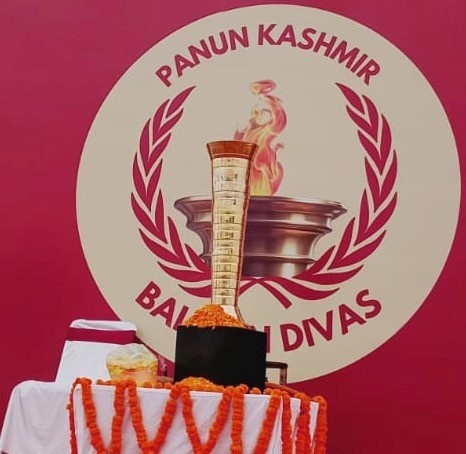
By Kuldeep Raina
FROM BALIDAN TO SANKALP:
Spirituality, Karm Kanda and the Sustenance of Panun Kashmir
Exile as Tapasya
Memory as Sanskar
Sankalp as Dharma
A political movement may be born from circumstances, but it survives only when its purpose becomes part of the collective consciousness of its people.
This is the deeper significance of Panun Kashmir. The movement emerged from the rupture of 1990, but its continuity cannot depend solely upon those who witnessed the Exodus. A struggle that extends across generations requires more than political resolutions and organisational activity. It requires memory to be preserved, practised and transmitted.
This is where Spirituality, Sankalp and Karm Kanda acquire political significance.
The observance of Kashmiri Pandit Balidan Divas on Monday, 14 September 2026, at Manhas Sabha Ground, Paloura, Jammu, demonstrated this growing consciousness. Despite a working day, hot and humid conditions and the competing demands of the Paan Festival, there was substantial participation and meaningful community involvement. Reports from Bengaluru, Canada and various other places were equally encouraging.
The importance of the occasion lay beyond the gathering itself.
It showed that collective political memory can become community practice. And once memory becomes practice, it acquires the possibility of becoming Sanskar.
From Memory to Karm Kanda :
Indian civilization has preserved its deepest memories through repeated acts of remembrance.
Ritual gives memory continuity, participation gives it life, transmission turns it into Sanskar.
The Kashmiri Pandit community can similarly give enduring form to its historical consciousness through the regular observance of its significant days.
Three dates are particularly important:
14 September — Balidan Divas: remembrance of sacrifice.
19 January — Nishkasan Divas: remembrance of the trauma and rupture of forced displacement.
28 December — Homeland Day: renewal of the resolve for restoration of the Homeland.
Together they create a meaningful sequence:
Balidan → Nishkasan → Sankalp.
They tell the story of what was sacrificed, what was lost, and what remains to be reclaimed.
When these days are observed year after year, with community participation and intergenerational transmission, they cease to be merely organisational programmes.
They become a living Karm Kanda of collective remembrance.
That distinction is crucial.
A political event ends when the gathering disperses. A ritual continues in memory. Sanskar continues in generations.
Balidan and the Responsibility of the Living:
Balidan is not merely an occasion for mourning. It is a reminder that sacrifice imposes responsibility upon the living.
We remember those who suffered and sacrificed because their memory places an obligation upon us to preserve what they stood for and to transmit that inheritance to those who follow.
Thus Balidan becomes Smriti,
Smriti becomes Sanskar and
Sanskar becomes Sankalp.
The observance of Balidan Divas acquires meaning when remembrance is joined with responsibility.
That is why the growing participation in Jammu and the simultaneous observances elsewhere in India and abroad are significant. Geographic dispersal need not result in civilizational fragmentation. A common calendar of remembrance can hold a dispersed people together.
Nishkasan and the Refusal to Accept Exile as Destiny
19 January, Nishkasan Divas, preserves another essential truth. Exile was imposed upon us. It was not our chosen destination. For my generation, displacement was not a historical abstraction. I was forced to leave Srinagar on the intervening night of 1–2 March 1990.
But the loss extended far beyond houses and property.
We were separated from our temples, sacred sites, ancestral hearths, family memories, language, traditions and the geography in which generations had lived their civilizational lives.
Exile therefore represented not simply a change of residence, but a rupture with sacred geography and inherited identity.
The passage of time cannot convert such an imposed condition into a fait accompli.
The question must therefore remain,Why should a forcibly imposed exodus be accepted as the permanent destiny of an ancient people?
In the historical consciousness of the Kashmiri Pandit community, the 1990 displacement is remembered as the seventh exodus. If repeated displacement is part of our historical experience, then the answer cannot be another temporary accommodation.
The cycle must end.
The objective is not merely to enable return, but to establish conditions under which another forced displacement becomes impossible.
Homeland as Sankalp
28 December, Homeland Divas, carries the journey from remembrance to resolve.
The Margdarshan-91 Homeland Resolution gave political expression to the conviction that Kashmiri Hindus have a right to live securely and with dignity in their ancestral habitat. It articulated the demand for a separate Homeland east and north of the Jehlum/Vitasta, with constitutional and political safeguards for the displaced community.
The significance of that vision lies in its transformation of grief into political purpose. The question changed from
What have we lost, What must be restored and secured for the future?
That is the essence of Sankalp.
Homeland Divas should therefore be understood not simply as the remembrance of a political resolution, but as the annual renewal of a collective commitment.
Spirituality: The Inner Foundation of the Struggle
The Homeland struggle acquires its deepest meaning when understood through the civilizational vocabulary of Dharma, Nyaya, Swabhiman and Punaragaman.
For me, Panun Kashmir has never been merely a political demand. The relationship between tKashmiri Pandits and Kashmir is ancestral, cultural as well as spiritual.
My return to Batapora after thirty-seven years reinforced this understanding. Standing before our abandoned ancestral home, performing pooja at its entrance and carrying its soil and sacred water with me was not merely an act of remembrance.
It was a renewal of belonging.
A house may be abandoned.
A generation may be displaced.
But the relationship between a people and their ancestral homeland cannot simply be extinguished by the passage of time.
This is why the struggle must not be reduced to property restitution or physical rehabilitation alone.
Punaragaman ( Comeback ) is ultimately about restoring a community's secure, dignified and creative existence within its ancestral civilizational space.
Exile as Tapasya, Sankalp as Dharma
Almost four decades of exile have tested the endurance of the community. Yet suffering need not end in despair.
When suffering is transformed into purposeful action, it can become Tapasya. When memory is transformed into resolve, it becomes Sankalp.
And when Sankalp is guided by justice rather than revenge, it becomes an expression of Dharma.The moral vocabulary of Panun Kashmir is clear. We do not seek another people's home. We seek restoration of our right to live with dignity and security in our own ancestral homeland.
Karm Kanda and the Sustenance of Panun Kashmir
Every long political movement eventually confronts the problem of continuity. The generation that experienced 1990 will not remain forever. The next generation did not experience the Exodus in the same way.
The generation after that may know it only through inherited memory.
This is precisely why observance matters. If every 14 September we remember Balidan, sacrifice remains alive.
If every 19 January we remember Nishkasan, the reality of exile remains part of our collective consciousness.
If every 28 December we renew the Homeland Sankalp, the political objective remains alive.
The calendar thus becomes an instrument of continuity. Memory becomes ritual. Ritual becomes Sanskar. Sanskar renews Sankalp. This is the deeper meaning of Karm Kanda in the life of a displaced community.
Remembering not merely by speaking, but by doing. It ensures that the Panun Kashmir movement is not confined to its founding generation. It becomes an inheritance.
A Civilizational Calendar of Resolve
The three observances can therefore be understood as three stages of one collective journey:
14 September — BALIDAN
We remember those who sacrificed.
19 January — NISHKASAN
We remember the rupture of exile.
28 December — HOMELAND
We renew the resolve for restoration.
Together:
Balidan → Smriti → Sanskar → Sankalp → Nyaya → Punaragaman.
This is more than a calendar.
It is a framework through which a displaced community can preserve its history, strengthen its identity and sustain its political purpose.
The journey from Balidan to Punaragaman is therefore not a journey from mourning to nostalgia. It is a journey from memory to responsibility, from responsibility to Sankalp, and from Sankalp to reconstruction.
The political struggle requires organisation.
Justice requires perseverance.
But continuity requires Sanskar.
That is why the observance of Balidan Divas, Nishkasan Divas and Homeland Day must increasingly become part of the collective Karm Kanda of the Kashmiri Pandit community.
For when a people remembers together, it remains conscious of who it is. When it practises that remembrance, it transmits it.
And when remembrance becomes Sankalp, exile can no longer have the final word.
Balidan must remain Smriti.
Smriti must become Sanskar.
Sanskar must sustain Sankalp.
And Sankalp must lead to Punaragaman ( Comeback ).
Our quest for justice remains unfinished. Our Sankalp remains alive.
(The writer is General Secretary of Panun Kashmir
Disclaimer: The views, observations and opinions expressed in above write up of Scoop News are strictly author's own. Scoop News does not take any onus or liability for the veracity, accuracy, validity, completeness, suitability of any of information in the above given write up. The information, facts or figures appearing in the write up in no way manifest the position, standpoint or stance of Scoop News and the Scoop News does not assume any encumbrance or answerability of the same. All disputes are subject to the exclusive jurisdiction of competent Courts and Forums in Jammu City Only)
Editor
Scoop News,(scoopnews.in)....
... |
| |
|
|
Share this Story |
|
|
|
|
|
|
|
| |
|
|
| |
|
|