| News Details |
| Panun Kashmir observes Anshan Sankalp in Jammu, reaffirms Five-Point Charter | | 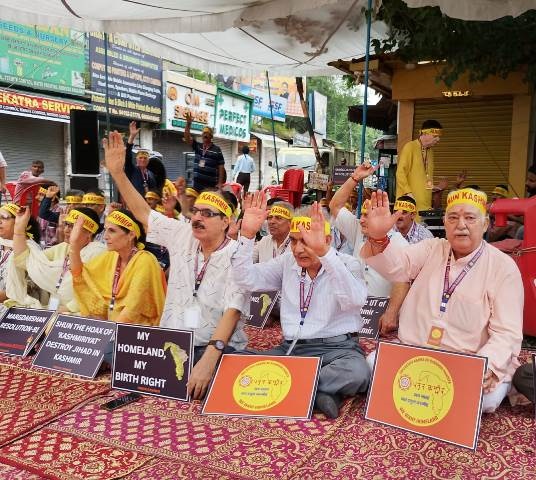
Jammu, September 05 (Scoop News)-In continuation of its sustained democratic campaign for justice, political security and a permanent solution to the plight of displaced Kashmiri Pandits, Panun Kashmir today observed a one-day Anshan Sankalp at Press Club, Dogra Chowk, Jammu, with 108 activists undertaking a token fast and reaffirming their resolve to pursue the organisation's five-point charter of demands.
The programme was organised in continuation of Panun Kashmir's major mobilisation at Jantar Mantar, New Delhi, on July 20, 2026, and witnessed participation of community activists, intellectuals, legal professionals and representatives of social and political organisations. The gathering maintained that the Anshan Sankalp was not an isolated protest but part of a continuing democratic movement seeking a comprehensive political, legal and socio-economic response to the displacement of Kashmiri Pandits.
The five demands reiterated during the programme were recognition of the genocide of Kashmiri Pandits, enactment of a Genocide Bill, carving out a separate Union Territory north and east of the River Jhelum as a secure homeland, creation of 15,000 posts in Central Government departments for unemployed and over-aged youth, and enhancement of ex-gratia and monthly relief.
The proceedings witnessed the participants reaffirming the purpose of the Anshan Sankalp and their collective resolve. The presence of 108 activists observing the token fast gave the programme a distinct character of collective commitment, with participants maintaining that decades of displacement had neither diminished the community's memory of its losses nor diluted its political aspirations.
Addressing the gathering, B.L. Kaul said recognition of the genocide was imperative for establishing historical truth and providing a foundation for justice. He maintained that the displacement of Kashmiri Pandits should not be reduced to an issue of migration or relief, as it involved the destruction of a settled social order and the uprooting of a community from its historical homeland.
Kundan Kashmiri, President, Kashmiri Pandit Conference (KPC), who travelled from Delhi to attend the programme, expressed solidarity with Panun Kashmir's Anshan Sankalp and emphasised the importance of maintaining unity and sustained democratic engagement on the issues confronting the displaced community. He said the participation of community leadership from outside Jammu demonstrated the wider significance of the demands and called for continued collective efforts to secure justice, political empowerment and a dignified future for Kashmiri Pandits.
Bhushan Lal Bhat stressed that recognition of the genocide must be accompanied by substantive measures of justice, rehabilitation and political empowerment. He also proposed that the existing Relief Department be upgraded into an autonomous Kashmiri Pandit Welfare Board, with an appropriate institutional mandate to address the long-term welfare, rehabilitation and socio-economic concerns of displaced families. He said such an institution would provide a more effective and accountable mechanism for dealing with the community's continuing needs.
Virender Raina described the Anshan Sankalp as a continuation of Panun Kashmir's democratic struggle and said the organisation would continue to place its demands before the Government and the nation through peaceful and constitutional means. He emphasised that the community's political aspirations could not be separated from its demand for security and dignified rehabilitation.
Senior Advocate P.N. Goja highlighted the legal dimension of the demands and underlined the need for a statutory framework capable of addressing genocide and mass atrocities. He maintained that recognition and appropriate legislation were essential to ensure that crimes of such magnitude were not reduced to political narratives or forgotten with the passage of time.
Col. Ajay Raina, Chairman, JPSM, said meaningful rehabilitation required more than the physical return of displaced persons. According to him, any sustainable solution must guarantee political security, constitutional protection and dignity to the community. He emphasised that the demand for a separate Union Territory was rooted in the community's experience of displacement and its search for a secure political future.
P.L. Kaul Badgami said temporary administrative and relief measures could not substitute for a permanent political settlement. He stressed that the objective must be to create an institutional framework capable of assuring long-term security and preserving the identity and rights of the displaced community.
Pyare Lal Raina reiterated that the community had consistently pursued its demands through democratic means and said the Anshan Sankalp reflected its determination not to allow the issue of displacement and the demand for justice to fade from public discourse.
Sanjay Raina said the five demands constituted an integrated charter rather than five unrelated issues. He observed that recognition and legislation addressed justice, the separate Union Territory addressed political security, employment addressed the future of the younger generation, and enhanced relief addressed immediate economic hardship.
Bittuji Bhat focused on the younger generation, stressing that displaced youth had inherited the consequences of a tragedy they had not caused. He called for concrete employment opportunities and said the proposed 15,000 Central Government posts would provide a meaningful intervention for unemployed and over-aged youth.
Akshay Garoo said the participation of 108 activists in the token fast was an expression of collective determination. He maintained that the younger generation remained conscious of its historical responsibility and would continue to carry forward the community's democratic struggle.
Shadi Lal Kaul Ravees, General Secretary, P.N. Bhat Memorial Trust, asserted that the only lasting solution to the Kashmiri Pandit issue was Panun Kashmir, which, he said, alone could provide the community with political security, dignity, preservation of identity and permanent rehabilitation in its ancestral homeland. He maintained that relief and employment measures were necessary immediate interventions but could not replace the need for a secure political arrangement.
Pyare Lal Pandita, Secretary Finance, Panun Kashmir, said the economic dimension of displacement required urgent and sustained attention. He stressed that enhancement of monthly relief and ex-gratia was necessary to meet the present economic realities confronting displaced families, while employment opportunities for unemployed and over-aged youth were equally imperative. He said economic rehabilitation must form an integral part of the larger political solution and should not be viewed as a substitute for it.
Prof. B.L. Zutshi said the community's struggle had to be understood in the context of its history, identity and continuing relationship with its homeland. He emphasised that preserving the collective memory, cultural heritage and intellectual traditions of Kashmiri Pandits was as important as addressing their material concerns, and asserted that any meaningful resolution must guarantee the community's security, dignity and continuity.
B.L. Jalali, President, Rainawari Action, emphasised that the issue involved not only physical displacement but also the preservation of the community's cultural and social identity. He called for a comprehensive approach addressing political, economic and cultural dimensions of rehabilitation.
Kuldeep Raina, General Secretary, Panun Kashmir, said the five-point charter represented a comprehensive political programme covering justice, legal protection, political empowerment, employment and economic rehabilitation. He said the Jammu programme had to be viewed in continuity with the July 20 protest at Jantar Mantar and demonstrated the organisation's determination to sustain the campaign until its demands were meaningfully addressed.
Manish Sawhney of Shiv Sena (Uddhav Thackeray) extended his support to the cause of the displaced Kashmiri Pandit community and expressed solidarity with Panun Kashmir's continuing democratic struggle. He said the concerns of the community deserved serious consideration and that its demands for justice, security and dignity should remain part of the wider public discourse.
In a detailed intellectual intervention, Tito Ganju, Chairman, Panun Kashmir, placed the question of displacement within broader philosophical and sociological frameworks, referring to materialism, dramaturgy, the analytical school and Kashmir Shaiv Darshan. He argued that the Kashmiri Pandit tragedy could not be adequately understood merely through statistics of migration, property loss, relief or rehabilitation.
Ganju said that dramaturgy and sociological analysis could help examine how communities are assigned roles, how collective narratives are constructed and how the experiences of victims can become marginalised within dominant public narratives. He argued that material consequences of displacement were only one dimension of a much larger rupture involving social relationships, collective memory, identity and civilisational continuity.
Referring to Kashmir Shaiv Darshan, Ganju said Kashmir's philosophical tradition offered a profound intellectual understanding of consciousness, identity and the relationship between the individual and the larger social and cultural order. In this context, he referred to jati-vidhvans, stressing that the destruction or fragmentation of a community's social and cultural existence must also be considered while understanding the consequences of displacement.
He maintained that the Kashmiri Pandit issue therefore required examination simultaneously through the lenses of history, law, sociology, political theory and philosophy, arguing that reducing the community's tragedy to a question of compensation alone would fail to capture the depth of the loss.
Dr. Agnishekhar, Convenor, Panun Kashmir, reiterated that the organisation would continue its democratic campaign for recognition of genocide, enactment of a Genocide Bill and creation of a secure political homeland. He said the demand for a separate Union Territory north and east of the River Jhelum remained central to Panun Kashmir's political vision and was intended to provide the displaced community with security, dignity, political empowerment and constitutional safeguards.
The programme was hosted by Akriti Raina, who conducted the proceedings and coordinated the various segments of the Anshan Sankalp. The gathering brought together speakers representing different strands of community activism and public life, reinforcing the message that the demand for a comprehensive political resolution continues to command sustained community support.
At the conclusion of the programme, Akriti Raina, while delivering the vote of thanks, expressed gratitude to ADC Jammu, SSP Jammu and SHO Nowabad Police Station for facilitating the peaceful conduct of the programme. She also thanked Vaker's Avenue for providing water bottles, which enabled the 108 participants to formally break their one-day token fast.
Panun Kashmir announced that its next major programme will be held at Manhas Ground, Paloura, Jammu, on September 14, 2026, on the occasion of Balidan Diwas, when tributes will be paid to the martyrs who sacrificed their lives, including members of the Kashmiri Pandit community and security forces. The organisation further announced that this programme will be followed by a demonstration at Jantar Mantar, New Delhi, on October 14, 2026, as part of its continuing campaign.
The Anshan Sankalp concluded with Panun Kashmir reiterating that its campaign would continue through democratic and constitutional means until its five-point charter receives a substantive response, maintaining that the unresolved question of the Kashmiri Pandit community remains fundamentally linked to justice, political security, constitutional protection, economic rehabilitation and preservation of civilisational identity, with Panun Kashmir as the proposed enduring political solution to the community's displacement.
... |
| |
|
|
Share this Story |
|
|
|
|
|
|
|
| |
|
|
| |
|
|