| News Details |
| Built, Burnt and Reborn: The Story of Jamia Masjid Srinagar | | 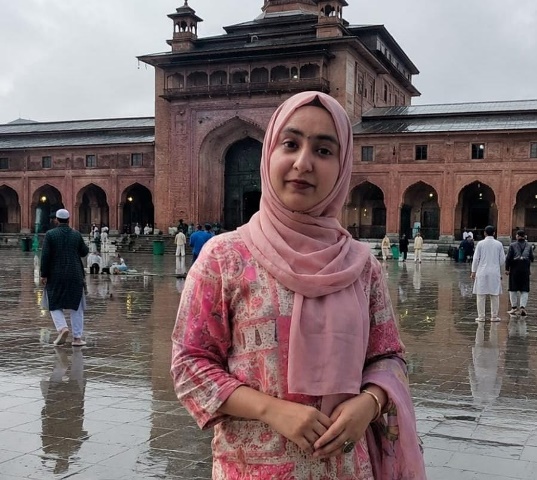
By Afreen Jan
In the historic heart of Srinagar, in the old city area of Nowhatta, stands Jamia Masjid, one of Kashmir’s most important religious and architectural landmarks. The mosque has been an important part of Srinagar’s cultural landscape for centuries, and its traditional wooden architecture, spacious courtyard, sloping roofs and four distinctive towers give it a unique Kashmiri character.
Jamia Masjid was built during the reign of Sultan Sikandar, a ruler of the Shah Mir dynasty, at the beginning of the fifteenth century. Historical accounts traditionally associate its construction with the period 1398–1402, while Sultan Zain-ul-Abidin, the son and successor of Sultan Sikandar, is associated with its later development and improvement. The mosque subsequently became an important centre of congregational worship and religious life in Srinagar. Its architecture reflects a combination of local Kashmiri craftsmanship and influences from wider Islamic architectural traditions.
The extensive use of timber, particularly in its numerous wooden pillars, is one of its most remarkable features. The mosque’s history, however, is also a story of destruction and rebuilding. A major fire severely damaged Jamia Masjid in 1479, after which reconstruction was undertaken during the reign of Sultan Hasan Shah.
The work continued after his death and was completed under Ibrahim Magre. The mosque suffered further damage during a major fire in Srinagar in 1620, during the reign of Mughal Emperor Jahangir, and was subsequently reconstructed. Later, during the reign of Aurangzeb, the mosque again suffered major damage from fire and was restored.
These repeated episodes of destruction and reconstruction demonstrate the remarkable resilience of Jamia Masjid and the importance attached to it by successive generations. For centuries, the mosque has served as a place of congregational prayer and religious gathering, particularly for Friday prayers and important religious occasions. Its location in the old city also connects it closely with the historic streets, markets and neighbourhoods of Srinagar.
Beyond its religious importance, Jamia Masjid represents the traditional craftsmanship of Kashmir, preserving architectural techniques and artistic traditions passed down through generations. Its wooden structure is a reminder of the skills of the craftsmen who built and maintained it over the centuries. Today, Jamia Masjid remains an important part of Kashmir’s architectural and cultural heritage. Its survival reminds us that historic monuments are not merely old buildings; they are links between generations and physical records of the societies that created them. For young Kashmiris, the mosque offers an opportunity to experience history beyond textbooks—in its wooden pillars, traditional architecture, courtyard and enduring presence.
As Srinagar continues to develop and modernise, preserving historic landmarks such as Jamia Masjid becomes increasingly important. Protecting such places does not mean preventing a city from moving forward; it means ensuring that development does not erase the history that gives the city its identity. Built during the medieval period, developed under successive rulers, damaged by devastating fires and repeatedly restored, Jamia Masjid has continued to remain an important part of Srinagar’s religious and cultural landscape. Its story is ultimately one of continuity and resilience. Built, burnt and reborn, Jamia Masjid Srinagar remains not merely a monument of Kashmir’s past, but a living symbol of its enduring heritage and historic identity.
(Aafreen Jan is an academic researcher and computer science writer,pursuing her master's at university of Kashmir)
(Disclaimer: The views, observations and opinions expressed in above write up of Scoop News are strictly author's own. Scoop News does not take any onus or liability for the veracity, accuracy, validity, completeness, suitability of any of information in the above given write up. The information, facts or figures appearing in the write up in no way manifest the position, standpoint or stance of Scoop News and the Scoop News does not assume any encumbrance or answerability of the same. All disputes are subject to the exclusive jurisdiction of competent Courts and Forums in Jammu City Only)
Editor
Scoop News,(scoopnews.in)
... |
| |
|
|
Share this Story |
|
|
|
|
|
|
|
| |
|
|
| |
|
|