| News Details |
| CM Omar Abdullah presents his second budget as Finance Minister | | “Safar Jaari Hai”: CM Omar Abdullah unveils people-first J&K Budget 2026-27 | 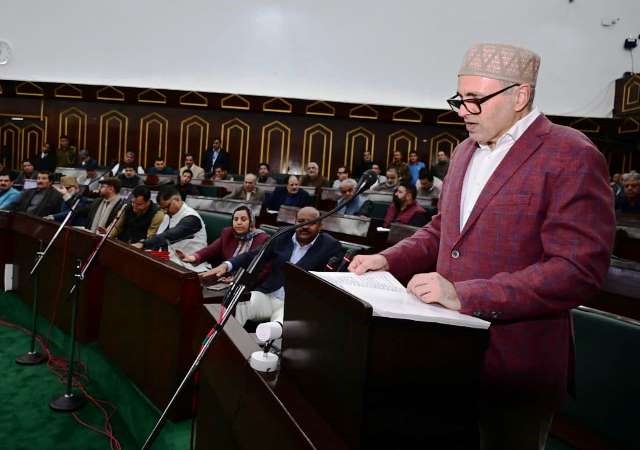
Jammu, February 06 (Scoop News)-Chief Minister Omar Abdullah today presented the Budget 2026–27 before the Jammu and Kashmir Legislative Assembly, marking his second Budget as the Minister of Finance saying that it would lay a strong foundation of enduring economic growth, social harmony and sustainable prosperity. He said that his Government is committed to transforming J&K into a modern, progressive and economically vibrant region.
The Budget carries a wide range of people-centric initiatives aimed at delivering immediate relief, strengthening social protection, promoting inclusive growth and ensuring equitable development across all regions of Jammu and Kashmir.
The Chief Minister announced 32 major welfare measures for the people in his Budget 2026–27 speech in the Legislative Assembly.
Among the 32 announcements, major welfare measures include financial support for AAY families through six free LPG cylinders per year; development of two Emergency and Trauma Hospitals at Uri and Poonch; bullet-proof ambulances for border districts of Poonch &Tangdar who suffer during cross-border firing and conflict, extending free ridership for women in Smart city buses & other Government transport, free bus services for differently abled passengers in public transport; procurement of additional 200 e-buses, DBT-based financial reimbursement of fees for AAY students from Class 9 to 12 and for college students; and sponsorship support to 6,000 orphans under non-institutional care.
A Poetic beginning and visionary commitment
Chief Minister Omar Abdullah began his Budget Speech with a couplet:
Safar Taveel Hai, Bhoj Bhi Bari Hai.
Par Har Surat, Yeh Safar Jaari Hai.
Jaari Hai…
Opening his address, the Chief Minister said:
“With deep humility and unwavering resolve, I rise today to present my Second Budget as Finance Minister. It is a privilege to be entrusted with the responsibility of shaping the financial future of our land. This Budget is not merely a ledger of figures; it is a fiscal compass charting our path towards a brighter horizon. It lays strong foundations for enduring economic growth, social harmony, and sustainable prosperity. As we embark on this shared journey, I invite every Hon’ble Member of this august House to come together and work collectively to build a strong and flourishing Jammu and Kashmir.”
Addressing the House, the Chief Minister, who also holds Finance portfolio, said that beyond sector-wise allocations, the Budget carries a set of focused measures that will directly touch the lives of citizens, particularly the most vulnerable sections. “These initiatives reflect our commitment to social justice, targeted welfare and long-term empowerment,” he said.
Budget Estimates and Fiscal framework
The Chief Minister informed that total gross receipts for 2026–27 are estimated at ₹1,27,767 crore, with net budget estimates at ₹1,13,767 crore excluding Ways &Means Advances and overdraft provisions.
Own revenues are estimated at ₹31,800 crore, while central assistance is projected at ₹42,752 crore, and CSS inflows at ₹13,400 crore.
GSDP for 2026–27 has been projected at ₹3,15,822 crore, reflecting 9.5% growth.
Boost to handicrafts, trade promotion and Unity mall
To strengthen the livelihood of artisans and promote Jammu and Kashmir’s globally renowned crafts, the Chief Minister announced enhanced budgetary support to the Jammu and Kashmir Trade Promotion Organisation (JKTPO). Regular Buyer–Seller Meets will be organised to create direct market linkages between local artisans and national and international buyers, improving branding, market access and income opportunities.
The Chief Minister also informed the House that financial support of up to ₹200 crore has been received for construction of the Unity Mall, envisioned as a permanent Crafts Bazaar and platform for local products, handicrafts, handlooms and traditional enterprises from across the country.
CM announced that J&K has been brought under Special Assistance to States for Capital Investment (SASCI) scheme by central government which offers 50 year interest free loan for taking up infrastructure projects saying that additional Rs 1431 crore has been provided under the untied component for disaster mitigation and restoration works. Under the third component of the (SASCI), Jammu and Kashmir has been allocated ₹210 crore, which will be leveraged to provide the UT’s share for eligible Centrally Sponsored Schemes.
Digital financial governance and institutional capacity building
Highlighting rapid progress in Financial Management Reforms, the Chief Minister said all Centrally Sponsored Schemes have smoothly transitioned from Treasury mode to SPARSH (State Payment, Receipt and Accounting System) mode. Aadhaar-based payments have been mandated for all DBT schemes.
Under SPARSH rollout, 151 SNA accounts have been opened with RBI, the Cyber Treasury is operational, sanctions exceeding ₹2,500 crore have been received, and over 23,000 bills have already been processed.
The Chief Minister proposed modernisation of the Accountancy Training Institutes at Srinagar and Jammu at a cost of ₹10 crore, and informed that a proposal for availing ₹350 crore under SASCI incentives has been submitted, placing J&K among leading States/UTs in transparent and citizen-centric financial governance.
Incentives for employees in remote and hardship areas
Acknowledging persistent vacancies in far-flung and difficult areas affecting service delivery in health, education and administration, the Chief Minister said the Government is actively contemplating a structured incentive scheme for employees posted in remote and hardship zones to improve retention and ensure equitable access to public services.
Priority employment for local youth in industries
The Chief Minister announced that all industrial units availing Government concessions—whether subsidy, electricity or land—will be required to give due priority to employment of local youth, ensuring industrial growth translates directly into jobs and income opportunities for residents of Jammu and Kashmir.
Major support for horticulture and agriculture
To protect horticulturalists from climate risks, the Chief Minister announced implementation of the Restructured Weather Based Insurance Scheme (RWBIS) for Apple (traditional and high-density), Saffron, Mango and Litchi, with total sum insured of ₹6,594.93 crore.
CM said that Holistic Agriculture Development Programme (HADP) scheme has ushered diversification of agri-economy and the scheme shall continue to boost agriculture. CM said that cultivated area had gone up from 12.71 lakh Ha to 13.50 lakh Ha while urging people to benefit from HADP &High Density Plantation schemes.
He also highlighted expansion of Controlled Atmosphere (CA) storage infrastructure. Currently, 68 CA stores with capacity of 2.92 LMT are operational against the requirement of 6.00 LMT. Additional CA capacity of 15,000 MT is being added in 2025–26, while 38,000 MT is targeted in 2026–27.
To ensure balanced regional dispersal, top-up subsidy for CA storage will focus on districts other than Pulwama and Shopian. The Government plans establishment of 40 CA stores with investment of ₹1,400 crore, including subsidy support of ₹600 crore from 2026–27.
The Chief Minister also announced 25% top-up subsidy for micro and sprinkle irrigation, earmarking ₹116.86 crore, benefiting farmers across 3 lakh hectares and enhancing water use efficiency by 60–80%.
An Aromatic and Medicinal Plant Mission with an outlay of ₹150 crore was announced, with ₹10 crore allocated in the next financial year.
Strengthening livestock sector through genetic improvement
To preserve high genetic breeds in livestock, the Chief Minister announced establishment of one Embryo Transfer Technology (ETT) Lab in every district with phased investment of ₹65 crore, following import of Dorper and Texel sheep from Australia and bulls from the USA.
Rural development and ODF-plus sustainability
The Chief Minister proposed strengthening rural sanitation and livelihoods through convergence of Central schemes, with special focus on achieving ODF-Plus status across rural J&K.
From 2026–27 onwards, District Capex funds will be leveraged for professional operation and maintenance of rural sanitation infrastructure, ensuring sustainability and improved public health outcomes.
Shri Amarnath Ji Yatra infrastructure modernisation
Reaffirming commitment to pilgrim safety, the Chief Minister said over 200 infrastructure works were completed during 2025–26 for Shri Amarnath Ji Yatra. He proposed further modernisation with an outlay of ₹180 crore in 2026–27 in partnership with the Border Roads Organisation to improve connectivity, emergency response and logistical support.
Education initiatives: JK e-Pathshalaand indoor games in schools
The Chief Minister announced launch of the JK e-Pathshala DTH Channel, a free-to-air platform delivering curriculum-aligned lessons from Class 1 to 12 without internet dependency. Over 300 educational videos have already been produced, with dedicated digital studios established.
From next year, class-specific channels will also be developed.
Indoor games facilities will be introduced in all Government schools to promote holistic development, with ₹18 crore earmarked.
Strengthening Anganwadi infrastructure
The Government will upgrade 1,000 Anganwadi Centres into modern Bal Vidyalayas with improved learning spaces and safety standards, at a cost of ₹72,000 per centre.
Additionally, 127 new Anganwadi Centres—one in each CDPO block—will be constructed to bridge infrastructure gaps.
Tribal welfare and livelihood promotion
An outlay of ₹70 crore was proposed for scholarships benefiting over 3 lakh tribal students, covering Pre-Matric and Post-Matric Scheduled Tribe learners.
To promote forest-based livelihoods, 100 Van Dhan Vikas Kendras will be set up with ₹15 crore. Tribal Home Stays will be supported with ₹5 lakh per unit, alongside a pilot artisan branding platform with ₹50 lakh.
Major healthcare strengthening and cancer control strategy
The Chief Minister announced commissioning of the extension block of Lal Ded Hospital, Srinagar, costing ₹118 crore, adding 108 beds and NICU facility, along with introduction of IVF services.
Construction of a 249-bedded Mother and Child Care Hospital at GMC Anantnag will begin in 2026–27.
Emergency Medicine Departments will be established in all Government Medical Colleges over the next two years.
PET scans shall be installed at GMC Srinagar and GMC Kathua.
Cardiology services will be expanded with Cath Labs at GMC Rajouri, Baramulla and Doda, with an outlay of ₹30 crore.
Recognising rising cancer incidence, the Government will roll out a Cancer Control Strategy in collaboration with NITI Aayog and ICMR, focusing on prevention, early diagnosis, improved treatment, and a population-based cancer registry.
Two dedicated Emergency and Accident Hospitals will be established at Uri and Poonch, along with procurement of bullet-proof ambulances for border districts.
Social Protection: Fee waivers, orphan sponsorship and free LPG cylinders
As a major step for educational equity, full fee waiver will be provided to all students from AAY families studying in Government Schools (Class 9–12) and Government Degree Colleges (UG level), not covered under other scholarships.
A Sponsorship Scheme covering 6,000 orphan children was announced, providing ₹4,000 per month through DBT.
To reduce household energy burden, the Chief Minister proposed provision of six free LPG cylinders per year to all AAY households in Jammu and Kashmir.
CM said that assistance under the marriage assistance scheme had been increased from Rs 50000 to Rs 75000 per beneficiary and that the eligibility condition of 8th pass was removed to benefit girls belonging to all poor families.
Commending the Budget to the House, the Chief Minister said, “This Budget strengthens welfare measures, accelerates infrastructure development, improves productivity and ensures a more prosperous and inclusive Jammu & Kashmir.”
“With these words, I commend the Budget for the financial year 2026–27 of Jammu and Kashmir to this august House for consideration,” he concluded.
Chief Minister announced development of new world class tourist destinations in collaboration with Ministry of Tourism, Government of India. He said despite the debacle due to the Baisaran incident which affected tourism, about 1.61 crore tourist visits were recorded during the current year. He said that Government is working on protecting the fragile eco-system at tourist destinations by investing in construction of Sewage Treatment Plants and solid waste management.
He said that an International Film Festival is being planned to be held shortly.
CM also spoke about the success of Mission YUVA, a flagship initiative to promote entrepreneurship and generate employment among the educated youth saying that 7000 persons had been onboarded on the App with 55000 DPRs prepared, 16000 applications sanctioned, 8000 budding entrepreneurs trained announcing that the Government is well poised to scale up this scheme to benefit youth and women.
Regarding the issue of regularization of Daily Rated Workers, CM said that the recommendations of the High Level Committee constituted shall be implemented to find a just and humane solution for their structured and phase wise regularization within the framework of law and fiscal responsibility.
Chief Minister also presented the supplementary statement of expenditure for the year 2025-26 before the House
Sunil Sharma strongly condemns J&K Budget calling it disgusting and disappointing
Jammu, 06 February 2026:
Leader of Opposition in the Jammu & Kashmir Legislative Assembly and senior BJP leader Sunil Sharma today launched a scathing attack on the 2026-27 Budget presented by Chief Minister Omar Abdullah, describing it as “disgusting and disappointing”.
In a strongly worded reaction, Sunil Sharma alleged that the budget has shattered the hopes and aspirations of all sections of society in Jammu & Kashmir. He accused the National Conference-led government of preparing a partisan document that disproportionately benefits constituencies represented by ruling party MLAs while completely neglecting the genuine concerns of the common people.
Sunil Sharma said that the budget fails to address the long-pending issues of daily wagers, who have been met with mere “toffees” instead of meaningful relief or regularization.
It shows no serious commitment toward providing employment opportunities to the unemployed youth of Jammu & Kashmir.
Promises made for poverty alleviation and welfare of weaker sections remain unfulfilled and appear to have been abandoned.
Funds have allegedly been shifted and allocated selectively to favour National Conference strongholds, turning the budget into a document “for NC MLAs, not for the people”.
The government is merely showcasing centrally sponsored schemes as its own achievements while failing to bring any substantial new initiatives or relief measures for the people of J&K.
Sunil Sharma termed the budget a huge betrayal of the people of Jammu and Kashmir, stating that it has dashed the expectations of every social class be it daily wagers, unemployed youth, middle-class families, or economically weaker sections.
The Leader of Opposition demanded that the government immediately reconsider its priorities and come out with concrete steps to address unemployment, regularize the services of thousands of daily wagers, and ensure equitable development across all regions of the Union Territory.
Sunil Sharma reiterated the BJP’s commitment to fighting for the rights and welfare of every citizen of Jammu & Kashmir and vowed to raise these critical issues both inside and outside the Legislative Assembly.
==== Chief Secretary Ladakh chairs LDMA meeting to review Disaster Preparedness and Mitigation Measures
Leh, 06 February 2026: The Chief Secretary of the Union Territory of Ladakh, Shri Ashish Kundra, today chaired a meeting of the Ladakh Disaster Management Authority (LDMA) to review disaster preparedness, mitigation measures, and disaster initiatives in the UT.
The meeting was attended by GOC of Army, Lt Gen Hitesh Bhalla, Lt Gen Chhabra, officers from Air Force, BRO, ITBP and Police department.
Officers from NDMA joined online.
During the meeting, Administrative Secretary, Disaster Management, Shashanka Ala, made a detailed presentation outlining Ladakh’s hazard profile, with special emphasis on earthquake and flash flood risks.
The presentation also included a rainfall and snowfall report of Leh town, along with an overview of the District Disaster Management Authority (DDMA) Acts and their implementation.
The meeting deliberated on several key agenda items, including the procedure for seeking post-disaster relief, a review of relief and reconstruction works undertaken by DDMA Leh, and the proposal for preparing a shelf of projects under the proposed Disaster Mitigation Fund of UT Ladakh.
The Chief Secretary emphasised the need to further strengthen disaster mitigation and preparedness mechanisms across the UT. He stressed the importance of robust inter-agency coordination and directed that the Army, Air Force, and Border Roads Organisation (BRO) should operate through an integrated control room to ensure a coordinated and effective response during emergencies.
He mentioned in particular the need for identification of disaster vulnerable spots and also modalities of mitigation and relief operations. He stressed upon the need of an integrated disaster management plan which would incorporate requirements of army, BRO, ITBP and other agencies. He also urged the police department to create a unified disaster mitigation force including civil defence, home guards and ex servicemen. He also underscored the need for identification of helipads and temporary landing grounds for helicopters in the eventuality of disaster.
He also underlined the necessity of providing institutional support for the establishment of an Integrated Command and Control Centre or operational system in Leh, aimed at enhancing real-time coordination, communication, and disaster response capabilities.
The meeting further discussed decisions and approvals sought from the State Executive Committee (SEC), with emphasis on timely action and adherence to established disaster management protocols.
Senior officers from concerned departments, representatives of the Armed Forces, and other stakeholders attended the meeting.
J&K Budget 2026 not People-Friendly, Youth-Centric: Hakeem Yaseen
· Says regularisation pledge quietly dropped as workers continue to wait for justice
· Says Budget failed daily wagers, casual labourers and jobless youth
Srinagar, Feb 06: President of the People’s Democratic Front (PDF) and former minister Hakeem Mohammad Yaseen on Friday came down heavily on the Omar Abdullah-led government, accusing it of presenting a “figure-heavy but people-light” Budget that has failed to address the most pressing concerns of Jammu and Kashmir’s working poor.
Reacting to the Chief Minister’s second annual Budget of Rs 1,13,767 crore (net), Yaseen said thousands of daily wagers, casual labourers, and anganwadi workers were once again left disillusioned, as the much-promised regularisation and enhancement of honorarium found no mention in the financial roadmap.
“The Chief Minister showered praise on daily wagers and anganwadi workers for their services, but praise does not put food on the table. These workers have been waiting for justice for decades, and yet the Budget offers them only assurances, not solutions,” Yaseen said.
He reminded the government that during the previous Budget session, Omar Abdullah had announced the formation of a high-level committee to work out a roadmap for the regularisation of daily wagers and ad hoc employees, promising that a policy would be announced in the next Budget.
“That promise has now been quietly buried under poetic speeches and glossy projections,” Yaseen remarked.
Calling the Budget “detached from ground realities,” the PDF chief said that while the government claims to be people-centric, it has ignored those who keep basic public services running.
“When nearly 60 per cent of expenditure is consumed by salaries, pensions and debt servicing, where is the space for social justice and employment security?” he asked.
Yaseen also questioned the sustainability of the government’s fiscal claims, noting that the tax-to-GDP ratio has declined from 7.5 per cent to 6.6 per cent, while fiscal deficit is projected to rise in 2026–27. “This reflects weak internal revenue generation and growing dependence on central assistance, which undermines the UT’s economic autonomy,” he said.
While welcoming welfare announcements like fee waivers, LPG cylinders, and scholarships, Yaseen said these measures resemble “relief packages rather than a long-term development vision.”
He added that unemployment, price rise, and job insecurity remain unaddressed despite tall claims of inclusive growth.
“The Budget talks of a ‘brighter horizon’, but for daily wagers, anganwadi workers and unemployed youth, that horizon keeps moving farther away,” Yaseen said, urging the government to immediately announce a concrete, time-bound policy for regularisation and fair wages.
He warned that continued neglect of vulnerable sections could deepen public resentment. “Budgets are meant to restore hope. This one risks eroding trust,” he added.
... |
| |
|
|
Share this Story |
|
|
|
|
|
|
|
| |
|
|
| |
|
|